
Stupp, Potocsnak united in effort to cure paralysis
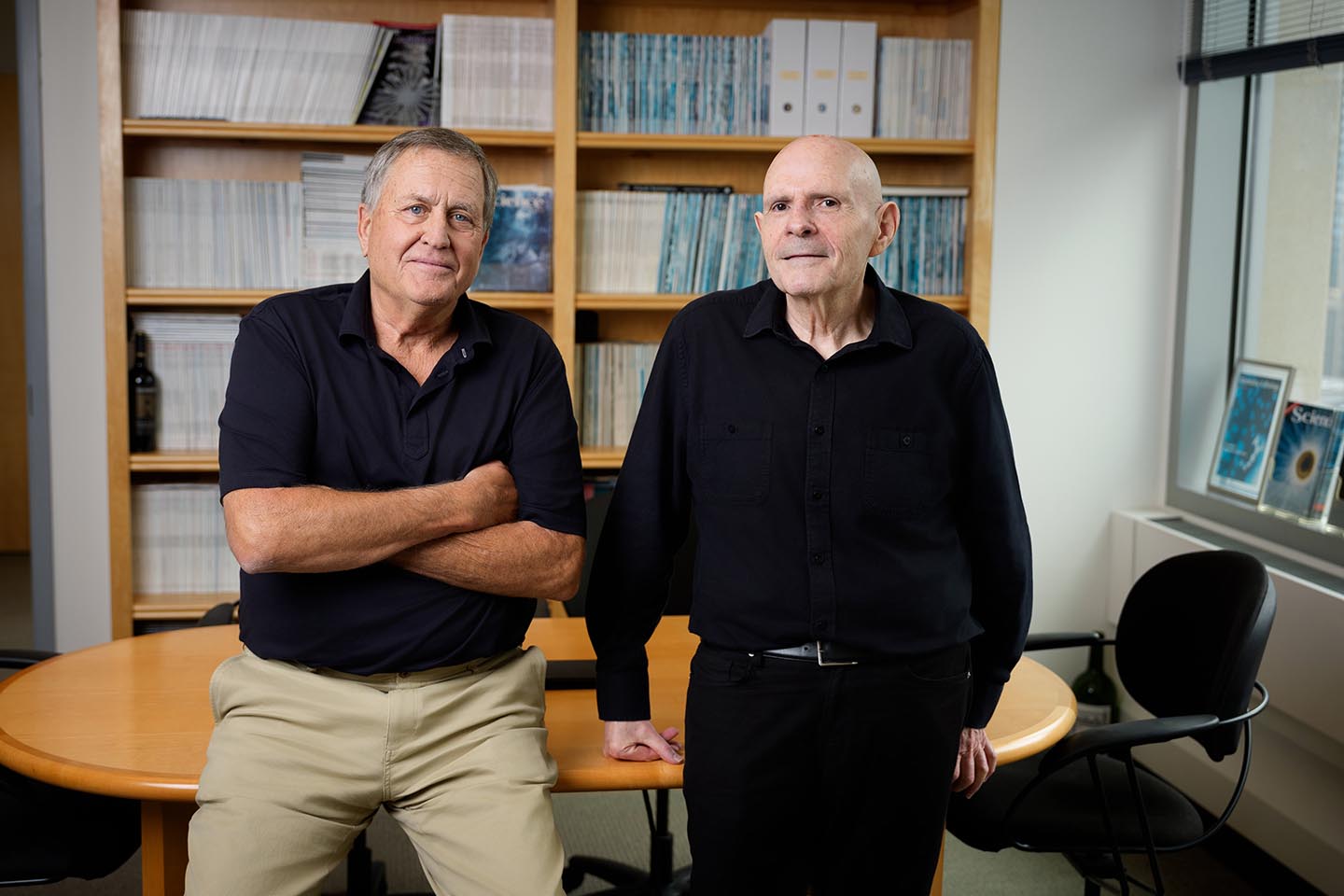 John Potocsnak, left, and Samuel Stupp both have personal connections to spinal cord injury patients that have inspired their partnership. (Photos by Jason Smith)
When a family friend’s son had a bicycle accident resulting in a spinal cord injury five years ago, John Potocsnak sprang into action.
Having just purchased a new house, Potocsnak decided to outfit his previous home with voice-activated technology and other features to enhance its accessibility. He then insisted that the paralyzed teenager and his family move from their split-level house into the more wheelchair-friendly property. He also approached Dr. Eric G. Neilson, the Lewis Landsberg Dean of the Feinberg School of Medicine at Northwestern University, with a new cause to support and a simple question: “How else can I help?”
It was a natural instinct for Potocsnak, a successful businessman who has generously supported many research initiatives at Northwestern. And his timing couldn’t have been better.
At the time, Northwestern professor Samuel Stupp was completing a blockbuster research paper describing “dancing molecules,” an injectable therapy that reversed paralysis and repaired tissue in a mouse model of severe acute spinal cord injury (SCI). Animals that received a single injection of the treatment 24 hours after injury regained the ability to walk within four weeks and showed significant evidence of regeneration in the spinal cord three months after injury.
Stupp had shared some of the preliminary results with Neilson, who introduced Stupp to Potocsnak and encouraged the professor to explain his vision for how he could advance his work toward treatment in humans.
After a couple of meetings, the Potocsnak family committed to an initial gift in late 2021 to support the translation of the therapeutic toward clinical trials in patients with new injuries, or acute SCI. The family has continued to support that effort through additional gifts and also contributed to a related project focused on adapting the therapy for use in patients with older injuries, or chronic SCI.
“I feel lucky to have been connected to a guy like Sam, because the work he and his team are doing is incredible,” Potocsnak said. “I want this research to be sustainable for the long term, but I also want Sam to see it reach clinical trials and witness how successful and impactful it could be. So, my approach is always, ‘Let’s get going.’”
“Advancing novel therapeutics like Sam’s work from the laboratory to clinical application requires both scientific innovation and strategic investment,” said Neilson, who is also vice president for medical affairs at Feinberg. “We are immensely grateful for the Potocsnak family’s generosity, which has been instrumental in accelerating translational spinal cord injury research at Northwestern.”
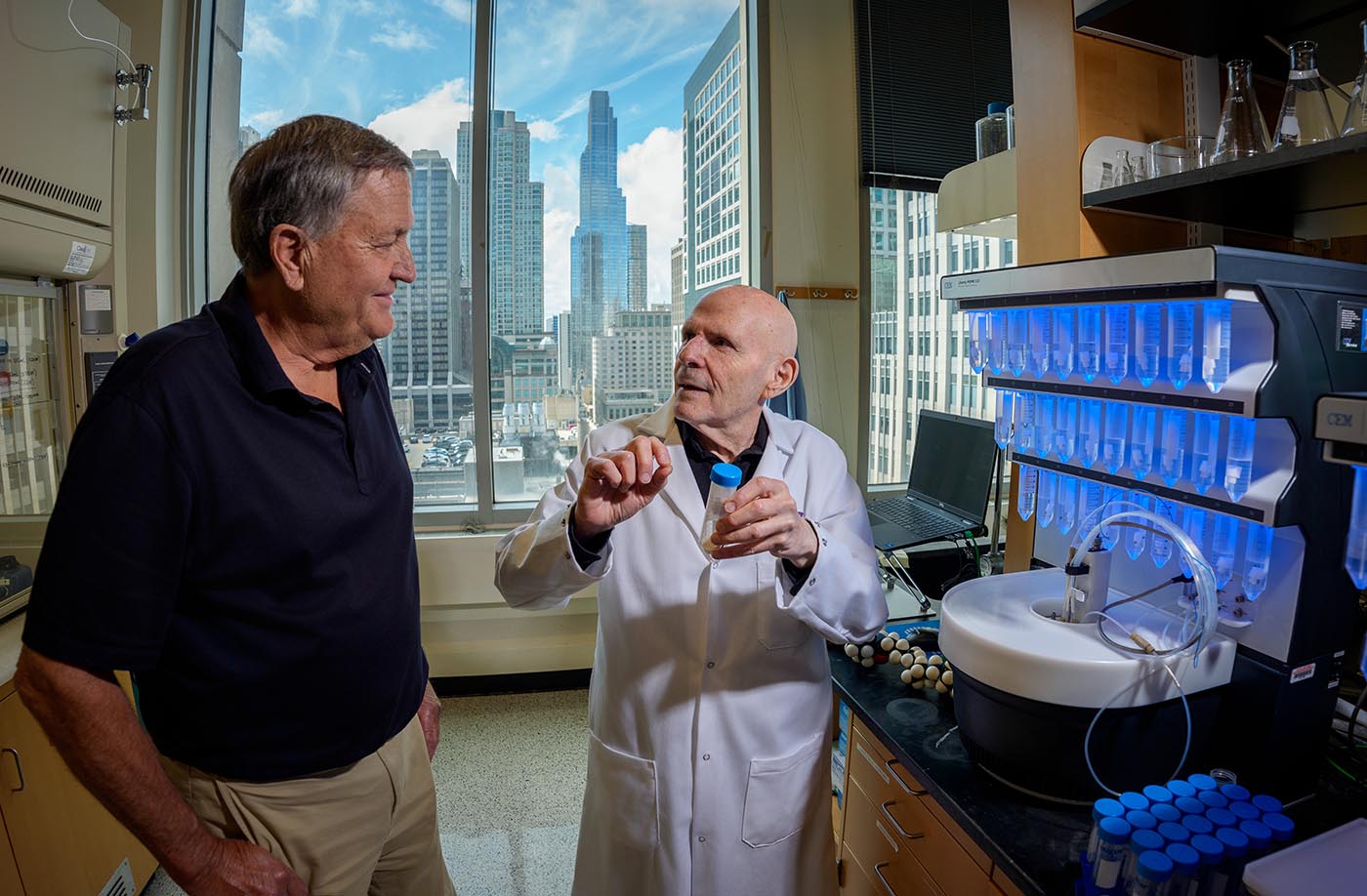
John Potocsnak, left, and Samuel Stupp in the laboratory where the molecules are made for the spinal cord injury therapy.
Partnership sparks progress
Over the past four years, the Stupp laboratory has validated its acute SCI therapy in a second animal model at a third-party facility — proving the strategy works on a different species and in a different laboratory environment. The team has also tested injections at different timepoints and achieved encouraging early results with the therapy in an injury model developed in the Stupp lab using human spinal cord organoids, which are essentially “mini organs” derived from stem cells. In addition, the researchers have developed novel therapies that show promise for the treatment of chronic injuries.
With the help of consultants, the scientists have initiated discussions with the U.S. Food and Drug Administration (FDA) and made significant progress in planning for first-in-human trials of acute SCI. In July, the treatment received an Orphan Drug Designation from the FDA, which includes financial incentives such as tax credits for clinical trials, exemption from user fees and up to seven years of market exclusivity after approval.
“The comprehensive support provided by the Potocsnak family has allowed us to drive this research forward from multiple angles, which is necessary to bring a brand-new treatment modality to the clinic,” said Stupp, director of Northwestern’s Center for Regenerative Nanomedicine (CRN) and Board of Trustees Professor of Materials Science and Engineering, Chemistry, Medicine and Biomedical Engineering. “We are very excited about our progress but recognize there is more work to be done.”
To administer the treatment, researchers inject the therapy into the region where a spinal cord injury occurred. The liquid then gels into a network of nanofibers built by millions of specially designed molecules. These nanofibers serve as a bioactive scaffold that delivers potent signals to cells to help them re-establish connections that were lost due to the injury.
By controlling the movements of the “dancing molecules” within the fibers, the team discovered that intensifying their molecular motion increases the therapy’s signaling power, leading to greater tissue regeneration and functional improvement in injured animals.
“The bioactive scaffolds developed by Dr. Stupp's team represent a promising state-of-the-art regenerative strategy for spinal cord injury,” said Dr. Michael Fehlings, professor of neurosurgery and co-director of the spine program at the University of Toronto, who was not involved in the research. “As a neurosurgeon focused on regenerative strategies, I find this technology to be extremely clinically relevant and attractive.”
Understandably, these results generated enormous excitement in the SCI community. Stupp has received thousands of emails from patients and family members asking when his technology will be available for use in humans — a flood of them in the weeks following the first “dancing molecules” publication in November 2021 and a steady flow of messages ever since. Each email is a story of tragedy, perseverance and hope from people whose lives were dramatically changed by falls, car accidents, gunshot wounds or other injuries.
The statistics tell part of the story. More than 18,000 new cases of SCI occur each year in the U.S., and approximately 300,000 people in the U.S. are currently living with SCI. Globally, more than 15 million people are living with SCI, according to the World Health Organization. Most of these people are expected to have some degree of paralysis for their entire lives, because there are currently no approved therapeutics for restoring function after SCI.
These facts are compelling on their own, but the personal narratives shared in the emails further drive home the urgency of developing a new solution for this devastating condition.
‘The power of hope’
One of those stories belongs to Keely Roberts and her family. Roberts and her twin sons, Cooper and Luke, were wounded during the mass shooting at the 2022 Fourth of July Parade in Highland Park, Ill., when the boys were 8 years old.
Keely and Luke recovered from their physical injuries. But Cooper, whose spinal cord was severed by a bullet, has been paralyzed from the waist down ever since.
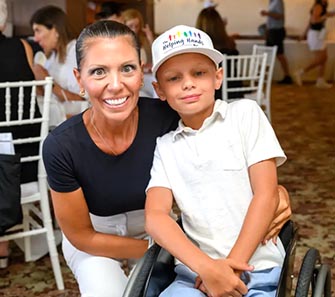
“For Cooper, the hardest part about this has been it changes how he sees himself,” Keely said. “Not only does the world see him differently, but his self-identity was tied to being an athletic kid, on soccer teams — the kid who wanted to go to the park the minute he got up in the morning and stay there all day.”
While researching potential treatments for her son, Keely came across Stupp’s work and eventually contacted him in January 2023. The two have spoken several times since then, with Stupp offering the latest updates on the research. Keely also shares updates on Cooper, who is now 11 and participates in several adaptive sports. He swims competitively and has played wheelchair baseball, tennis and basketball as well as sled hockey.
“I’m a big believer in the power of hope, and it’s probably why I’m so dialed into what Professor Stupp is doing,” she said. “I’ve done more research on this than the average person, and it’s the only thing that gives me hope that Cooper’s current condition doesn’t have to be the condition he’s in for the rest of his life.”
Stupp carries these stories from the Roberts family and so many others with him as his research team aims to push their regenerative therapy into clinical trials, possibly as soon as 2027. They are starting with acute spinal cord injury, to prevent newly injured individuals from becoming paralyzed, but are committed to tackling the more challenging existing injuries as well.
“Spinal cord injury is one of the most devastating injuries that someone can experience in terms of its impact on quality of life, and it can happen at any age,” Stupp said. “I’m extremely motivated to advance this research as quickly as we can, because it’s addressing a tremendous humanitarian need.”