CRN: Center for Regenerative Nanomedicine

News

Read below for the most recent news from CRN. For news from previous years, visit our News Archive.
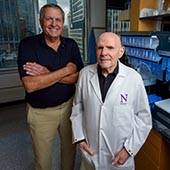
John Potocsnak and Samuel Stupp posing in a research laboratory

Stupp, Potocsnak united in effort to cure paralysis

January 13, 2026
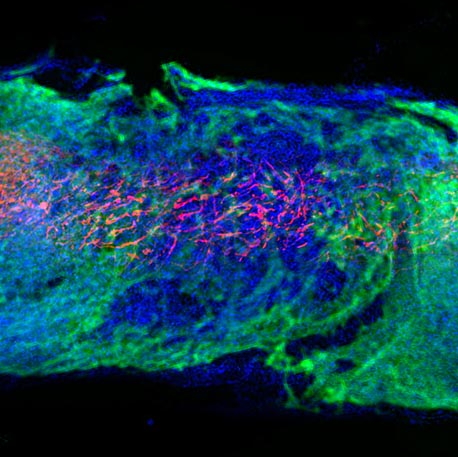
With support from John Potocsnak and his family, CRN director Samuel Stupp has made significant progress over the last four years in advancing an innovative therapy for spinal cord injury.

Post-stroke injection protects the brain in preclinical study

January 8, 2026
A CRN research team led by Ayush Batra and Samuel Stupp published a study describing an injectable therapy that protects the brain after ischemic stroke, the most common type of stroke. In a mouse model, the therapy successfully crossed the blood-brain barrier and significantly reduced brain damage.
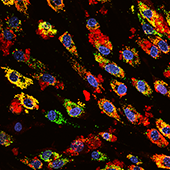
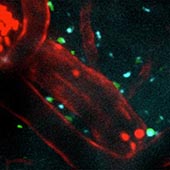
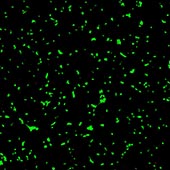
A micrograph of neurons with the mis-spliced KCNQ2 gene.

A new clue to ALS and FTD: Faulty protein disrupts brain’s ‘brake’ system

October 30, 2025
A new study using patient nervous tissue and lab-grown human neurons has uncovered how a key disease protein, TDP-43, drives overactive nerve cells in the neurodegenerative diseases amyotrophic lateral sclerosis (ALS) and frontotemporal dementia (FTD). The research, led by CRN member Evangelos Kiskinis, not only explains a long-standing mystery of why nerve cells overfire in ALS and FTD but also highlights a promising new drug to slow or prevent disease progression.

‘Dancing molecules’ treatment receives FDA Orphan Drug Designation

July 16, 2025

Dancing molecules,” the promising new treatment for acute spinal cord injuries developed by CRN director Samuel Stupp, has received Orphan Drug Designation from the U.S. Food and Drug Administration (FDA).

The FDA’s Orphan Drug program is designed to encourage and support the development of treatments for rare diseases or conditions. The designation’s benefits include financial incentives such as tax credits for clinical trials, exemption from user fees and up to seven years of market exclusivity after approval.

C. Shad Thaxton portrait

Targeting tumor metabolism to trigger cancer cell death

June 9, 2025
Northwestern University scientists led by CRN member C. Shad Thaxton have developed a promising approach to killing treatment-resistant cancer cells by exploiting their hidden metabolic vulnerabilities, according to a study published in the Proceedings of the National Academy of Sciences (PNAS).

Sugar-coated nanotherapy dramatically improves neuron survival in Alzheimer’s model

May 14, 2025

A research team led by CRN director Samuel Stupp has developed a new approach that directly combats the progression of neurodegenerative diseases like Alzheimer’s disease and amyotrophic lateral sclerosis (ALS).

In these devastating illnesses, proteins misfold and clump together around brain cells, which ultimately leads to cell death. The innovative new treatment effectively traps the proteins before they can aggregate into the toxic structures capable of penetrating neurons.

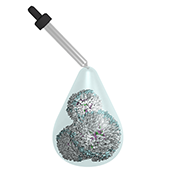
An illustration of eyedrops that use synthetic nanoparticles to help the eye regenerate cells.

Regenerating eyedrops help damaged corneas heal

May 7, 2025
Northwestern University researchers including CRN members C. Shad Thaxton and Vinayak Dravid have developed first-of-their-kind eyedrops that use synthetic nanoparticles to help the eye regenerate cells that have been damaged by mustard keratopathy, or exposure to mustard gas, and other inflammatory eye diseases.

Rivnay elected into AIMBE College of Fellows

April 1, 2025

CRN faculty member Jonathan Rivnay was elected into the 2025 class of American Institute for Medical and Biological Engineering (AIMBE) Fellows, the AIMBE announced. He was cited “for making pioneering contributions in the field of conducting polymers, bioelectronics, and medical devices.”

The AIMBE College of Fellows comprises the top 2 percent of medical and biological engineers, honoring those who have made outstanding contributions to engineering and medicine research, practice, or education.

Press:
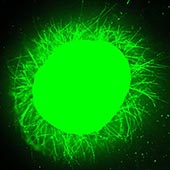
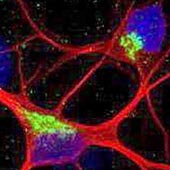
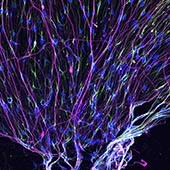
An immunofluorescence micrograph stained to show neurofilaments

Understanding how neurofilaments clog up brain functions

March 11, 2025
Northwestern University scientists have uncovered new insights into how neurofilaments act like Velcro in neurodegenerative diseases, clogging up the brain and preventing normal function. The research, led by CRN faculty member Puneet Opal, was recently published in the journal JCI Insight.